Roll Credits

A little bit of appreciation goes a long way

I think of being a content creator in the digital age a kin to a paralegal working at a law firm – one does all the work while the other reaps the rewards and benefits. In the law office, it’s the paralegals who do all the legwork, ie. the research, client building, filing, and follow up, while the attorney simply signs their name and receives the praise of a job well job. [ DISCLAIMER: THIS IS AN EXAGGERATED OPINION OF THE ATTORNEY/PARALEGAL RELATIONSHIP BASED ON PERSONAL EXPERIENCES. HOWEVER, THE MAJORITY OF ATTORNEYS I KNOW ARE NOT LIKE THIS. ] In most cases, the paralegal does receive some form of gratitude and appreciation from the attorney they work for, and for most paralegals, this small act of validation is enough, while others may decide to seek employment elsewhere, relocate to a different area, or pursue a different career calling altogether. This isn’t all that different, in my opinion, than a content creator who devotes massive amounts of time and energy into developing and perfecting their digital creations and sharing their work on the open web. When you pour time and energy into anything, it creates a kind of intrinsic value and the attention born into such a project is deserving of appreciation and acknowledgment. This is why it’s important to validate not just the work of the creator, but the creator themselves as well. One way of doing this is through proper attribution when we share or reproduce the work of someone else online, much like we would do if we were citing a reference in a scholarly research paper. Whether its in an academic setting or a virtual one, It’s important that we all give credit to the original authors and creators of the content we share online.

Personally, I’m much like the paralegal mentioned above who is happy enough just to receive the occasional accolades from the attorney she works for – probably because that was me for many years. However, now there’s a certain level of accountability involved. If I’m going to attach my name to something and share on the web for everyone to see and critique, I better make sure it’s good!
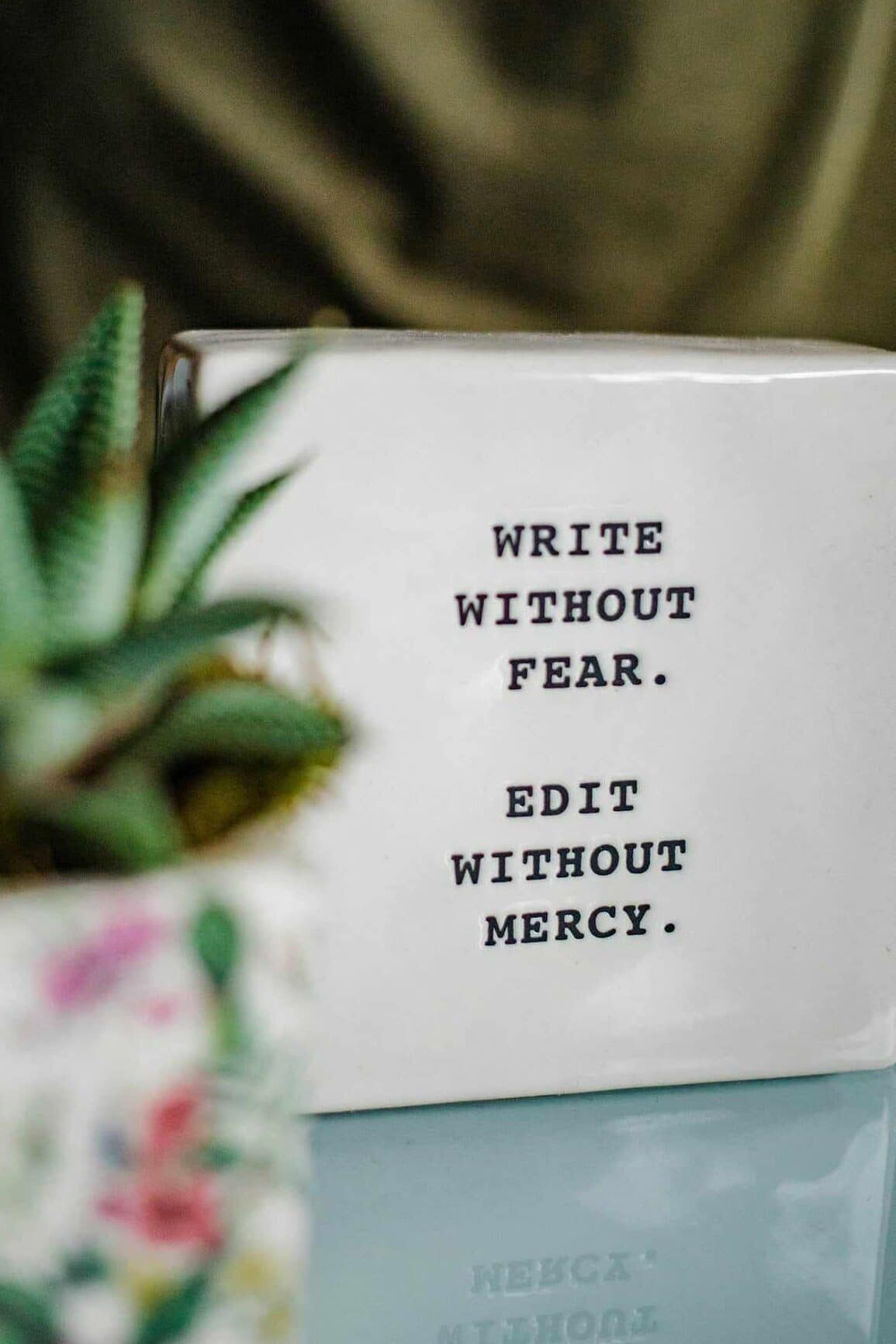
a-white-box-with-writing-on-it-next-to-a-plant
Shout out to Hannah Grace who shared this on unsplash.com

It’s important to me that I leave this world better than I found it. This ideal of making a positive difference, regardless of how small, is woven into my very identity, as I discussed in my last blog entry Who Am I?. Through a sense of altruistic purpose and the potential to reach more people through a broader media outlet, I am working to establish within myself and my community a foundation of hope built on empathy, authenticity, and charity. But I also I understand and value how precious and fleeting time is, and since I won’t waste my time on anything I wouldn’t be proud to put my name on, I believe it’s appropriate to license my work in a way that preserves the original intention but also allows others to share the message if they want to.
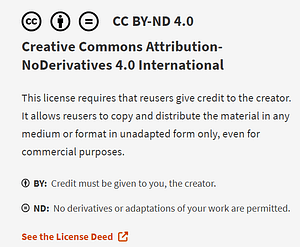
Screenshot of text from creative commons website detailing the requirements of the cc by-ND license terms

I’ve created a lot of online content throughout the years, and to be honest, never paid much attention to copyrighting or credit attribution, mainly because my circle of influence was always so small. However, now that my online presence is growing, so is the reach of my ideas, and likewise the need to be credited adequately and appropriately is also growing. There is value in the countless hours that go into creating and perfecting the stuff I put online, either for this class, or as part of my personal brand building on social media, even if the value is strictly relevant to me and measurable only in how much a moment of time costs when it’s something you know you can never get back. This is why I chose the creative commons license that I did. I don’t mind if people copy, share, or even make a profit off my work, as long as they acknowledge and appreciate the effort and time that I put into it.

Sharing is Caring: The Golden Rule of Copyright Laws

If you’re gonna use it, you must attribute it! Besides the immoral aspect of claiming someone’s hard work as your own, it is also illegal in the United States thanks to copyright laws which protect a creator’s intellectual property from the moment it is created and published onward. There’s no need to apply for a patent that could take years to be approved, or complete some lengthly form every time you upload your latest artwork to Instagram. You created it, and you get to decide how, if at all, it is used once it’s live in the digital world. At least, that’s the very broad concept of copyright protection laws. But the truth is, most of the content we see online today is merely a remix of some kind of yesterday’s internet fad. I can remember being warned that whatever I post on the internet will last forever, and that if I didn’t want it coming back to haunt me when I was older, then I shouldn’t put it online in the first place. Back then, this was partly because we didn’t have the same level of security or government monitoring [read censorship] that we do today. But also because most of us were just too excited to finally have an audience for our creative endeavors. As the first generation to experience AOL chats and message boards, where “ASL?” was common lingo to us, but foreign language to our parents, we knew no bounds in the amount that we shared online, despite the frequent dire warnings from our elders. And I think that kind of freely given, freely shared mentality is what fuels the open-source initiative in today’s digital environment. Except now, we are the elders and our children are teaching us a thing or two about being “cheugy”. (Don’t know what that means? I didn’t either – I had to look online for today’s lingo translations. )

When I think about how much things have changed between the days of dial up and Snake on your cell phone, I also recognize how much things stay the same. Information is readily available at our fingertips whenever we seek it, and the ability to share our thoughts and ideas across not only state lines, but also across political, cultural, and generational divides is truly a marvel of today’s digital advancements. But the driving force behind this incredible expansion of digital access and accessibility is something that has driven human growth since the dawn of the time – human connection. We, as members of the human race, all crave human connection and it is what drives us to keep reaching forward and pushing the lines of what we once believed to be impossible in the ever prevailing quest to feel connected, authentically, to another person. And as long as the desire to connect is still pressing the boundaries of our self-limiting ideals, then I’ll still be here, trying to tie it all together for the rest of us.
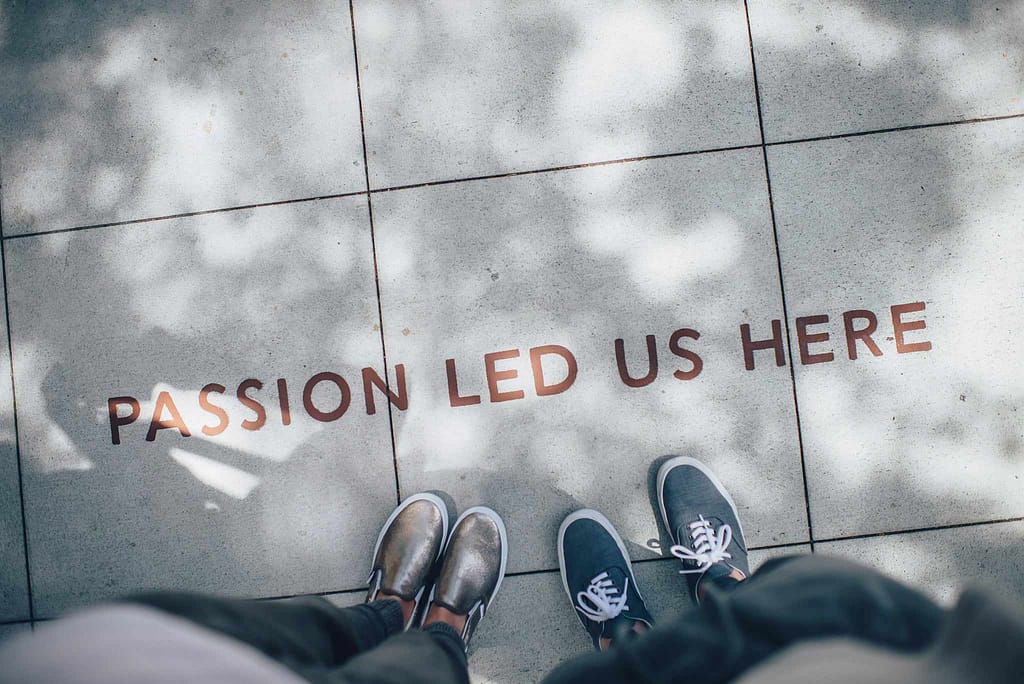
image of a sidewalk from the perspective of two people looking down at their feet with the text "Passion Led Us Here" written on the sidewalk
Give a shoutout to Ian Schneider – downloaded from unsplash.com

Copyright and Attribution

Why we use copyright?

Image displays words such as "Copyright", "Idea", "Protection", "Licensing", "Product", "Intellectual", "Patent", "Law", "Global", and "Ownership".
Image by matdesign24. Image found on pixabay.com

I chose the license of CC BY-NC 4.0 because I want people to be inspired by my work and to be able to make it their own. Although, I do not want people making a profit off of it. Copyright is very important, as it gives creators the rights to their own work and provides legal protection. It promotes the production and sharing of art, while keeping it ethical.

Using Other Works Ethically

Closeup of a chalkboard with the words, "Do what is right, not what is easy". Includes a compass.
Image by mohd izzuan. Image found on pixabay.com

Throughout all of my education, we were constantly reminded to cite our work and to give credit to others. Back then it seemed tedious and a lot of work, but it is important as we should always give credit to the original creators of the works that inspire us. The internet is open to everyone in order for people to build off of each other’s ideas, but there are important steps to take in order to make sure no work is stolen. To read more on how to use other people’s work ethically, read Karl Mundt Library’s Citation Guide.

Summer’s Thoughts on Copyright and Ethical Usage

Caring About Copyright

My Reflection About Copyright and Licensing

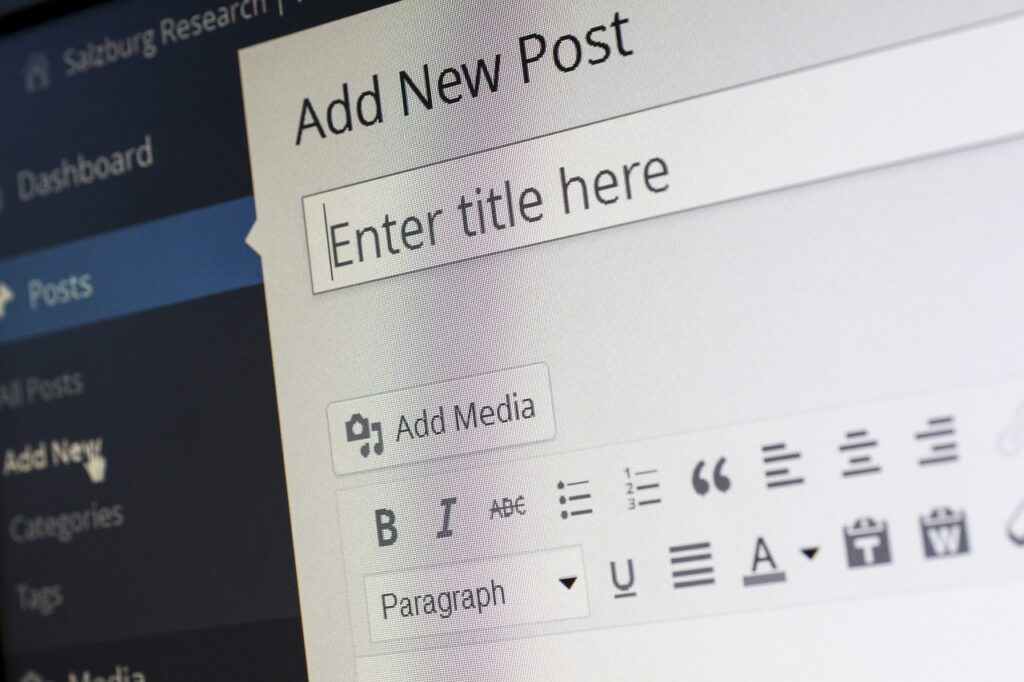
Image of computer screen showing the "posts" page of WordPress and blank field for adding a title to the new post.
Image by Werner Moser from Pixabay.com

After completing this week’s module from my DGST101 class regarding the importance and guidelines for copyright, fair use, attributions, Creative Commons (CC) license, etc., I’ve come to view the way we regard pieces published to the internet differently. Previously, I’ve always had preconceived negative connotations with copyright – solely based off of how unnecessarily complicated it seemed and how scary the consequences may be if you are caught copyrighting. However, I didn’t realize all of the ins and outs of copyright until now, and how it begins. Before, I had thought it would be a lengthy process to have those words usually seen at the bottom of an internet page, “This work is licensed under…” meaning that there are plausible restrictions to using said person’s work. However, I’ve now come to know that copyright begins right when the piece of work is created! In fact, it is solely up to the creator (not the US Copyright Office) on how the work is shared. Therefore, I’ve found the components of copyright to be incredibly helpful in allowing creativity, innovation, and boundaries all in the same sense. Copyright allows others to create imaginative pieces of work, while still allowing respect for the original creator – yet another amazing perspective of the internet! Reflecting on this, I chose a fairly flexible CC license for my work. I made use of the CC license chooser to help produce the best license to support my work and boundaries. Therefore, I wanted those to be able to use, remix, and work upon my original piece without being restricted to the same boundaries as myself – all while still giving myself credit for the original work.

Effects of Ethically Using Other’s Work

My Thoughts on Being Ethically Creative

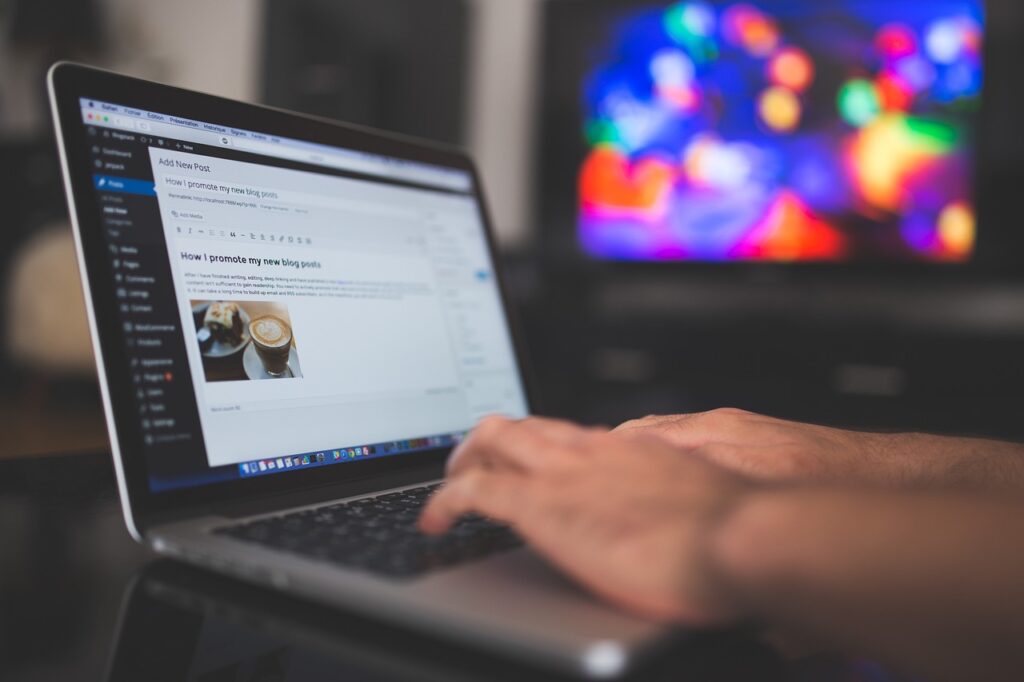
A person typing a blog post on a laptop.
Image by StockSnap from Pixabay.com

After considering the fact that CC licensing allows for the respect of an original creator’s boundaries, it would be completely inconsiderate to ignore the guidelines of usage for the creator’s content. Thus, leading to unethical usage of another person’s work. Examples of this can be using images for a blog post, like the one above, and not attributing who and where the image originated from (assuming it didn’t come from a copyright-free resource). Instances like I mentioned previously happen more often than not, leading to bigger companies dropping requests for copyright takedowns like grenades (as cleverly put by Casey Fiesler in her TedTalk, “How the Internet and Copyright Fuel Creativity”). These grenades frequently take down pieces of work that are covered under fair rights (often for commentary, etc.) due to the fact that it’s intimidating to fight for set rights against a big company. Thus, it’s incredibly important to take the extra minute or two to ethically use other’s work by properly attributing the original creators based upon their CC licensing – in order to allow everyone to continuously be creative and innovative.

Copyright And Attribution

Reflections on copyright

I understand that copyright is where all right are reserved. One needs permission to use one’s owns work. As I reflect on it, copyright and attribution is a way individuals get credit for their work. The reason why I chose the copyright because it allows others to use, edit, and remix my website.

How do you use copyright ethically

A lamp, books, a flower vase and candle holder on top of table counter

By using copyright ethically ask for permission to use the work or give credit to the one who owns the work.

Work By Karoline-Grabowska

A picture of curtains, candle and two pots
Work by Warion-Taipei

Copyright & Attribution

Why is Copyright important?

Copyright is important because it prevents people from losing credit or money for hard work and forces other creators to be original. It ensures that individuals receive recognition and compensation for their hard work and originality. This incentivizes past creators to keep creating because they know their ideas won’t be stolen. Additionally, it forces others who want the recognition that comes from creating to develop new ideas and not coast off of others’ innovations, which benefits individual creators and contributes to the growth of various industries, ultimately enriching our society.

Pen writing "Be Creative." Decorative Image.
Picture by Ramdlon from Pixabay

I chose the copyright that I did because I don’t care if others copy and redistribute the material in any medium or format. If another artist remixed, transformed, and built upon my work, I would be flattered. However, as the original creator, I deserve the credit for being the source material. I think it’s also helpful to consumers who discover my work through another artist; they can easily locate me and my work if they want more content. For the most part, I don’t care what my work is used for as long as I’m credited.

Using Others’ Work Ethically

In order to use someone else’s work ethically, it can’t be copied or passed off as one’s own; it should be built upon or used to inspire another piece of work. This could be done by using the original piece as a foundation to build upon or by combining elements from the original creation with new ideas. Furthermore, the original creator must be credited when one piece of work inspires another. Crediting helps acknowledge the artist’s contribution to the work and ensures they get the recognition they deserve.

Woman typing on laptop. Decorative Image.
Picture by Deeezy from Pixabay

Copyright and Attribution

Importance of Copyright

Copyright is important because it encourages people to share their work with others while knowing their creativity will be compensated and protected. Under copyright and fair use laws, ideas can be remixed and creations can be parodied, often leading to new ways of thinking that benefit everyone.
I chose to add the CC BY-NC-ND 4.0 Creative Commons copyright license to my website because it is the most restrictive. Although others can share my work if they give me credit, I like that they can not edit or use it commercially.

Ethics

It is best practice to give credit whenever someone else’s work is used, whether it is licensed or not copyrighted work. For example, this includes crediting the original creator by name and linking the original work. It is important never to use watermarked images, as this indicates that the creator does not want their work shared. Fortunately, there are plenty of works that are not copyrighted and are available in the public domain.

Crafting My Web Identity

A professional young woman named Erin with a big smile.

The Face Behind the Domain Name

Hello world and welcome to my first website! I am Erin Lynne and I will be taking you with me through the world of learning digital studies. I am a Communication and Digital Studies major at the University of Mary Washington and part of my Introduction to Digital Studies class was to create my own website, so sit back, relax, and enjoy learning alongside me!

Personalizing My Online Presence

I picked the domain name “Intro 2 DGST” because I wanted to keep it simple so that I know this is where my posts for this class are. I also wanted a unique flair with the full name of the class included. This will be my personal site where information I learn in my Introduction to Digital Studies class will be. Having this simple yet unique domain name will allow others to understand what it is they are viewing.

The Importance of an Online Identity

How you want others to perceive you online is of utmost importance. Establishing who you are and why you are sharing content on your site is crucial for building the foundation of creating a successful reputation on the web. I want to leave a lasting impression on those that take an interest in what it is I am sharing. In doing so I will publish content that is original and authentic, clearly defining my personality.

Who am I on the Web?

My online identity is a reflection of my values and my skills. While crafting who I am on the web I received some helpful practices from Tips for Creating a Professional and Authentic Online Identity. This is an online communication forum where professionals on LinkedIn have offered advice to the discovery of one’s web identity. I want to be as authentic as possible, and I have achieved this by defining my goals for this website and curating it for the people who I want to connect with. This website will be a learning experience for both the viewers and I as I dive into the world of digital studies. Creating my personal spin on each post will reflect a vision and goals for my online identity.

Happy Learning!

Copyright and Attribution

Why copyright?

Reflections on copyright

After reading and learning more on copyright, I now know why some people chose to copyright their work, and others don’t. I learned all about different types of copyright and the different forms of access. It’s also important to give credit where it’s due. Or even attribution if credit isn’t specified. I think it’s important to educate yourself and know about how to identify if media is copyrighted or not. It’s also important to know where you can find free use media so you know where to find copyright free media every time you need it.

Why I chose my copyright

For my copyright, I chose to let other people post my work elsewhere, with credit. People can also use my work for commercial purposes. But, in unadapted form. Which means they can’t change or remix my work. I chose this copyright because I don’t mind people using my work as long as they give proper credit.

Ethically using others work

Why is it important?

Copyright is so important for many reasons. People work really hard to take photos, videos, and produce media for us to consume. If they don’t want their work to be used they absolutely have the right to refuse anyone to use or recycle variations of their work. If they require credit-give it!

Copyright free photos

A ladder leaning up against a bookshelf in a library
Photo by: Marina Leonova via Pexels
A big wave about to crash
Photo by: Emiliano Arano via Pexels

Copyright in the Creative Digital Space

Overview

Why Is It Important?

In today’s digital world, open access to creative work is as important as ever. However, to prevent the recycling or stealing of artists’ original work, it is important to provide guidelines and restrictions in order to protect work and encourage new creations. Many creators choose to use standard copyright laws that require individuals to seek a license in order to use their work, but many others may also choose to other methods, such as publishing a work directly to the public domain or simply requiring attribution when a work is distributed.

How Is This Site Protected?

For this site, I chose to use CC BY 4.0, or a type of copyright that requires attribution. Essentially, if someone wanted to use the work on the site for remixes, adaptations, or distributions, I would simply just have to be attributed. I chose this option because I would still be credited for my original work while still allowing others to build upon it or distribute it with less restrictions, something I believe is very important in the creative process.

A red shield with a check mark in the middle appears on a computer screen.
Photo by Reshot. Found on Reshot.com

Copyright Rules to Remember

When using the works of others, it is important to educate yourself on copyright restrictions, especially the copyright license attributed to the specific work. While encouraging creativity based on the work of others is a very important part of the creative process, it’s important to make sure the efforts of others and the structure of their original work is recognized by using the proper licensing and attribution. For more information, visit the Creative Commons Website.

A man with blonde hair raises his finger with an idea, while a lightbulb next to him illuminates.
Photo by Reshot. Found on Reshot.com

Copyright and Attribution

Reflections

My License

I learned more about copyright throughout this module. Copyright is legal framework to protect a creator’s rights to their original work. The goal of copyright is to maintain the integrity of creative works as the creators get to decide how their work is distributed and used. As the creator of my site, I own the copyright to it. I chose my license so I can encourage others to share my work while giving me credit for what I completed. I wanted to allow collaboration and others to build off of my work, while still accrediting my ideas.

Others’ Work

Using the work of others ethically allows you to respect the creators while sharing work by understanding copyright terms. Attribution is important when using work ethically in order to honor their work. Fair use plays a crucial role because you will be able to decide the appropriate timing of when to use work without permission. Licensing is also important as you must legally understand how to use other people’s work. Being ethical allows each individual to serve and gain a sense of respect.

Photo of books on a couch representing peaceful moods.
Photo by Mauri Studio: Pexels
Image of a lion running through the grasslands
Photo by Youngafrikanna .: Pexels

css.php