Final Project

Summary

For my final project, I decided to make a portfolio with my writing projects. I created three different projects pages; one for poetry, one for long essays, and one for recordings of poetry readings. Building this portfolio is so important as a writer because it acts as a collection of my work accessible for future employers and publishers. I was also hoping the multi-media and multi-medium aspects of the website would make it more accessible and enjoyable for website visitors.

Accessibility

To make this project more accessible, I added subtitles to the recording of the reading, created headers to make screen reading easier, and added alt text to the pictures.

Media Credit

While most of the pictures were taken by me or a friend of mine at an event, I gave credit to Reshot in accordance with their copyright restrictions, which was to attribute them to their images with otherwise no restrictions on the image’s use. The rest of the media was attributed to me. The site favicon and header were both created by me using templates found in Canva.

Information Accuracy

Since the content I posted for the website was creative and advertised as creative, I made sure the information was accurate by editing the creative works and only using my original work.

Copyright Licensing

I chose to use the same copyright licensing for this website and the work published on this website as I did for this website because it gives people the opportunity to creatively use and distribute the content posted while still attributing my original work to me.

AI Use

AI was not used to create this project at any point.
Final Project Plan

Overview

For my final project for Intro to Digital Studies, I have decided to make a portfolio for my creations as a writer. The site will adopt several different media types and represent my scope both as a writer and digital creator.

Media Types

In this project, I want to create three sections within the website: one for my poetry, one for my long creative essays, and one for videos/audios that correlate to my poetry (ex. readings, videos that go along with narration, etc.). This domain will reflect who I am professionally, so I want it to be as creative and true to myself as I can make it. Through WordPress functions and customization options, I hope to be able to make it more of a domain of my own I can use even after college. I also believe that this website will truly culminate what I have learned this semester through the use of different media types embedded into the website.

Educating the Future of Education: A Look into the UMW Education Department in Light of the National Teacher’s Crisis

Interactive Infographic

Visit this link for an interactive version of this graph.

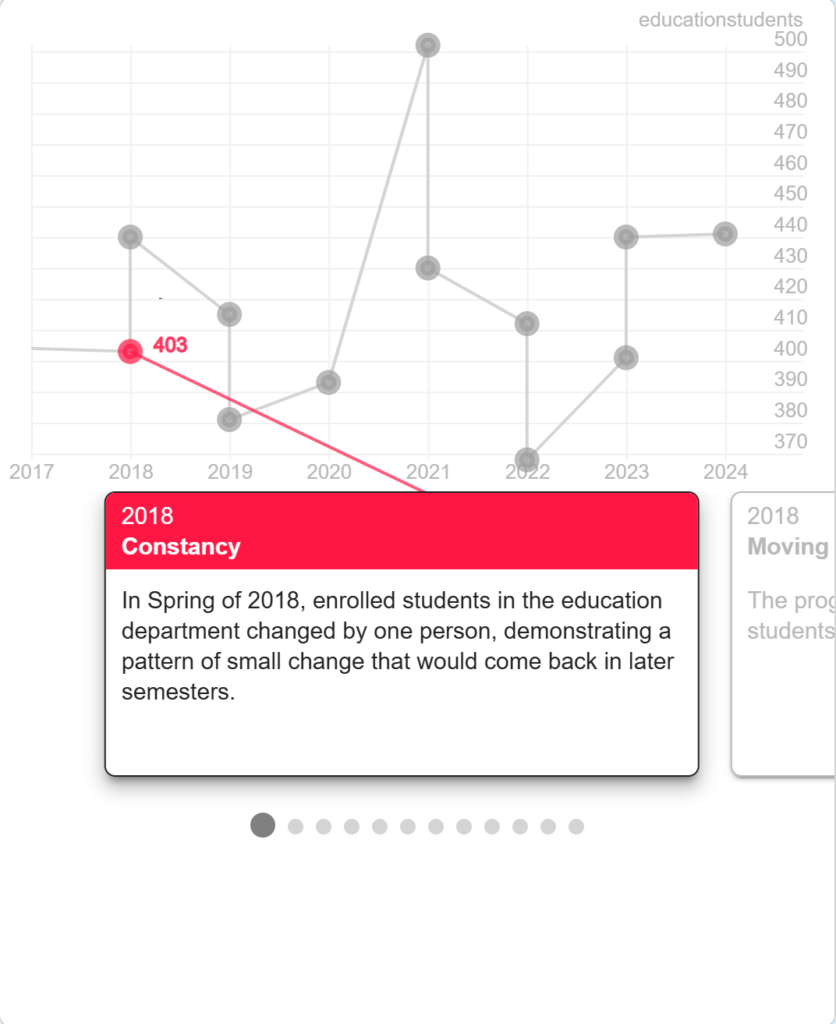
A text box labeled "2018- Constancy" points to a highlighted point with a red 403 next to it. The textbox reads, "In Spring of 2018, enrolled students in the education department changed by one person, demonstrating a pattern of small change that would come back in later semesters."

Background

Diving Into the Data

In this project, I sought to investigate the enrollment of students in the UMW education department and examine if/how the number of students changed as the teachers shortage evolved in the US. By examining this data, taken from the annual Grade Distribution Report from UMW’s Institutional Analysis and Effectiveness department, I found a story surrounding curriculum education at UMW that was much different than I expected. Although the number of students enrolled in education classes was not the highest out of the departments at UMW, it was not the lowest either. In fact, the department did not only decrease in the number of students enrolled in education classes, as I had deduced due to the national teachers shortage, but had rather increased or remained stable as a whole. While COVID caused the loss of data for the Spring 2020 and smaller numbers in the Fall 2020 semester, the department was able to recover from COVID, initially growing in the number of students enrolled and eventually leveling off to stable enrollment numbers higher than the Fall 2017 students the data set began with. For more information, check out this Excel Sheet with the data on the number of education students each semester.

What Does This Mean?

While the nation faces a national teachers shortage, the number of students interested in entering the education field, while decreasing initially, has grown to stable, relatively high numbers of enrolled students. This proves that an interest in working in education field remains. Examining data sets and stories such as this one is so important because it allows federal, state, and local education officials to source the problems of the teachers shortage. This data set proves that there is not a decreasing interest in the education field, but rather other factors, such as poor working conditions and pay, that may be causing the teachers shortage. As the child of teachers, the importance of examining the causes and effects of the teachers shortage is important for keeping schools a safe space for learning for all children, with all the necessary resources for learning.

Software and Processes

To make this infographic, I used Excel to decipher the data and create a clean and effective table. This data was then imputed into a Google Sheets form that was used to create an infographic through Storyline’s system.

Credits and AI

AI was not used at all in the creation of this project. All media was created through the Excel or Storyline programs.

Examining Education Majors at UMW- Data Project Check In

Topic and Trend

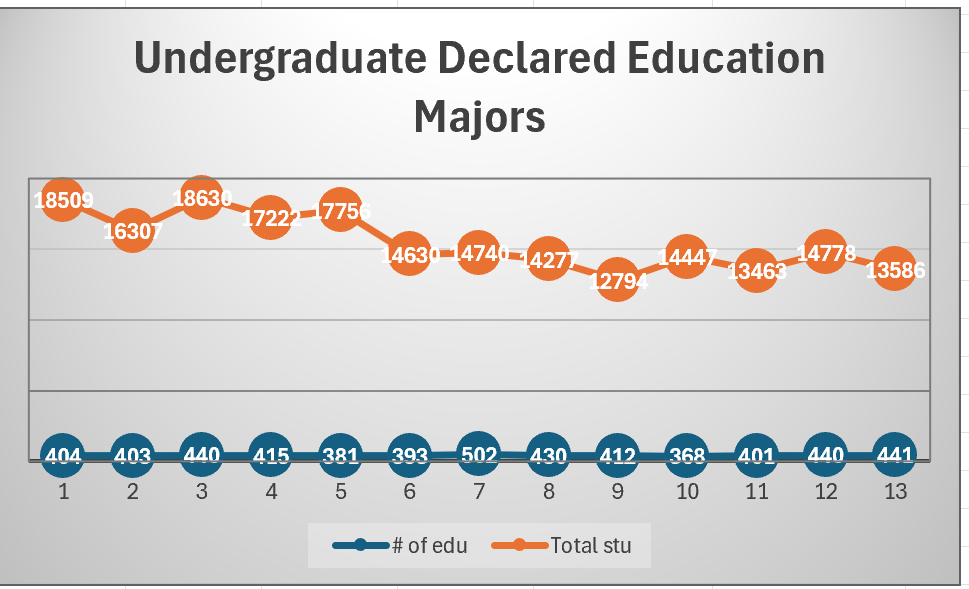
For the data trend project, I decided to examine the number of declared education majors at UMW compared to the whole student body. The United States is going through a teachers crisis, and I was hoping that examining the number of students majoring in education might explain a trend that mirrors the number of current teachers in the US to try to identify what is causing the shortage in teachers in America today. Examining the data through the table and chart revealed that while the number of students at UMW studying education remained relatively low, the number of education majors remained steady even increased after COVID, though decreased in the the most recent years. I found this data set through the UMW Grade Distribution Report. The full data set can be found through this Excel Sheet.

A chart titled "Undergraduate Declared Education Majors" depicts a first data set, the total number of undergraduate declared students, steadily decreasing over time. The second data set, the number of declared education undergraduate students, steadily decreases and then increases overtime.

Process

The trend of the number of declared education majors at UMW decreasing and then steadily increasing overtime was found through Excel. After looking at the Grade Distribution Report, I copied the number of total declared education majors for each semester onto an Excel sheet (excluding Spring 2020, which did not have any data due to the change in grading systems as a result of the COVID outbreak. After creating a table, I copied the data into a pivot table, which helped me create a more visual line graph to represent the changes in the number of declared education majors and total undergraduate students with declared majors. Through the chart, I was able to identify that the data first decreased, increased, and then decreased overtime. The steady decrease in the years after COVID may represent a possible trend in teaching conditions after COVID, though the data resembled pre-COVID data closely.

Heavy Is the Hand That Holds the Spoon: A Video Experience

Video

Video Transcript

My is Meaghan Van Dyke and I’m the host of Heavy is the Hand That Holds the Spoon, a look into the Mary Washington college dining experience. Welcome to our first and only episode.

For many students, college is their first experience of true Independence and the first time that they are relied upon to make meals for themselves. The question remains, how did students actually use the kitchens that are given to them in their University accommodations? To find out, we interviewed Eagle Landing residents and sophomore University of Washington, Riley Munford

I’m here with Mary Washington sophomore Riley Munford, who is a first-time apartment resident. Riley, would you mind telling me a little bit about what you like to cook in the apartment and where did you learn to cook that?

“Tonight for my friends, I am making a recipe that my aunt actually got in Europe when she was traveling abroad, and I think my family took took it and adapted it to an American sense of the meal. But I learned to cook it like growing up in my house with my mom, and we have this whole process of like all of these specific steps that we have to take. I’ve always had people tell me that there’s a more efficient way to do it but there’s like just a tradition of the specific, like way to make it that makes it homey.” “Yes!”

For University officials, understanding students eating habits is an important way to make sure that all students are accounted for and cared for. This has been Meaghan Van Dyke and this is been the first and only episode of Heavy is the Hand That Holds the Spoon, a look the Mary Washington dining experience.

Behind the Scenes

About

This video follows the experience of learning to cook in a college environment. In the podcast specifically, I interview my friend Riley, a sophomore at UMW and a first time apartment resident. While Riley talks about her experience cooking a very yummy tomato basil pasta meal, the video features me trying my best to recreate the meal under Riley’s instruction. To learn more about helpful cooking tips for beginners, visit this Kroger page on ways to improve your cooking methods. For a recipe specifically similar to Riley’s tomato pasta recipe, check out this tomato and garlic pasta recipe!

Editing and Recording

To record this video, I rented a tripod from the HCC and used the camera on my phone. The tripod with my phone proved to be the most efficient recording method with the best quality. I chose Canva for my video editing software, as I could both easily create my video’s logo through Canva and arrange and crop the videos faster. Finally, YouTube allowed me to edit my captions and control how I shared my video more clearly, prompting me to chose the streaming service for my project.

Attributions

While I recorded the videos myself, the graphic I created for the video’s logo was developed using the “Modern Minimalist Skincare Blog” template on Canva. A special thank you goes out to my roommates for helping me set up and eat the meal I prepared in this video, and for Riley for allowing me to interview her/film her welcoming me into the apartment 🙂

Video Outline- Heavy is the Hand that Holds the Spoon

Shot List

List of types of shots intended to be used in the Video Project

Test Recording

Transcript

“Hi! My name is Meaghan Van Dyke and this is the test recording for the Digital Studies podcast into video project. For dinner tonight, I had McDonald’s.”

Equipment

To record this test recording, I used a makeshift stabilizer that I will use for the cooking shots in the video in order to get the most scope of the stove during the cooking scenes. For the other shots, I plan to use a tripod stabilizer. Since a majority of the shots will be filmed in the kitchen, I decided to use the natural kitchen lighting to create a more realistic kitchen environment for viewers.

Recording Information

For this project, I plan to use graphics for the title card and the closing shot to establish the podcast and its content. The two close ups I’ve planned for this project, the close up of the Eagle Landing doors and the food cooking on the stove, are used to establish the details of the setting and additional sensory details of the meal. The only planned medium shot of the video, Riley cooking at the stove, establishes Riley the detail of the cooking process and the setting of the kitchen itself. The several establishing wide shots, such as the shots of Eagle Landing and Riley cooking in the kitchen, establish a greater understanding of setting, which plays a significant role in the main focus of the podcast, college apartment cooking itself.

Heavy is the Hand That Holds the Spoon: Podcasting the UMW Dining Experience

A microphone icon with sound waves on a blue phone screen.
Picture by Reshot. Found on Reshot.com

Podcast Audio

Transcript

My is Meaghan Van Dyke and I’m the host of Heavy is the Hand That Holds the Spoon, a look into the Mary Washington college dining experience. Welcome to our first and only episode.

For many students, college is their first experience of true Independence and the first time that they are relied upon to make meals for themselves. The question remains, how did students actually use the kitchens that are given to them in their University accommodations? To find out, we interviewed Eagle Landing residents and sophomore University of Washington, Riley Munford

I’m here with Mary Washington sophomore Riley Munford, who is a first-time apartment resident. Riley, would you mind telling me a little bit about what you like to cook in the apartment and where did you learn to cook that?

“Tonight for my friends, I am making a recipe that my aunt actually got in Europe when she was traveling abroad, and I think my family took took it and adapted it to an American sense of the meal. But I learned to cook it like growing up in my house with my mom, and we have this whole process of like all of these specific steps that we have to take. I’ve always had people tell me that there’s a more efficient way to do it but there’s like just a tradition of the specific, like way to make it that makes it homey.” “Yes!”

For University officials, understanding students eating habits is an important way to make sure that all students are accounted for and cared for. This has been Meaghan Van Dyke and this is been the first and only episode of Heavy is the Hand That Holds the Spoon, a look the Mary Washington dining experience.

Recording Process

Equipment and Editing Process

This podcast was recorded using the voice memo feature on my phone. The speakers from the bottom of the phone acted as the microphone to interview my friend, Riley, and record ambience of Riley cooking in the kitchen with my roommates. The podcast was edited using Soundtrap, a free audio editing software.

AI Use

AI was not used at any point in the planning, recording, or editing processes.

Credit and Attribution

The intro music, titled Lazy Day- Stylistic Futuristic Chill, was found on Pixabay, a royalty free music site that does not require attribution.

For more information on how to create a similar tomato pasta recipe to Riley’s (though nothing can beat the original), visit the Salt and Lavender food blog. For more information on the Eagle Landing kitchen accommodations, visit the Residence Life page.

Heavy is the Hand that Holds the Spoon: Podcasting the UMW Home Dining Experience- Outline

Topic

For the podcast assignment, I chose to create a podcast on student’s experience with learning how to cook while on campus. For many students, college is the first taste of independence, which means many students are beginning to experiment with cooking on their own with a limited college budget. Through this podcast, I want to explore what college students choose to make come meal time and how being on campus affects this decision.

Outline

0-20 Seconds

Ambience of kitchen, people talking while eating food in the background

Introduction of place (Mary Washington student accommodations- types of kitchen)

Introduce main question of Podcast (Are students cooking in their accommodation kitchens? How have their cooking habits changed since they’ve been in college?)

Podcast Title (Heavy is the Hand that Holds the Spoon: Podcasting the UMW Dining Experience) and introduction of host (Meaghan Van Dyke)

20-30 Seconds

Upbeat, contemplative music

Introduction of two University accommodations (Eagle Landing and UMW Apartments)

30-55 Seconds

Ambiance of cooking in kitchen

Introduction of Eagle Landing interviewees

First interview (what do you like to cook? Why? Where did you learn to cook this?

55-80 Seconds

Ambiance of kitchen, people talking

Introduction of UMW Apartment interviewees

Second interview (what do you like to cook? Why? Where did you learn to cook this?

80-100 Seconds

Contemplative music

Interviews with both UMW Apartments and Eagle Landing residents (Do you feel like you are limited with what you could make with finances/ accommodation appliances?)

100-110 Seconds

Why does this topic matter?

Interviews with both UMW Apartments and Eagle Landing (Why does this topic matter to you/UMW faculty)

110-120 Seconds

Conclusion and sign-off

Ambient kitchen sounds

Test Recording

Transcript

“Hi! My name is Meaghan Van Dyke, and for breakfast I had two chocolate chip muffins and for dinner I will have pizza.”

Audio Recording Details

This recording is set in my home kitchen, since the ambience of cooking in the background matches the ambience of cooking in a college dorm the closest. I recorded this using the voice memo feature on my phone, which gathers audio from the speakers at the bottom end of the phone. I did not use AI at all in the process of planning or recording this podcast episode.

Digital Art Creation in the Modern Age

Favicon Creation

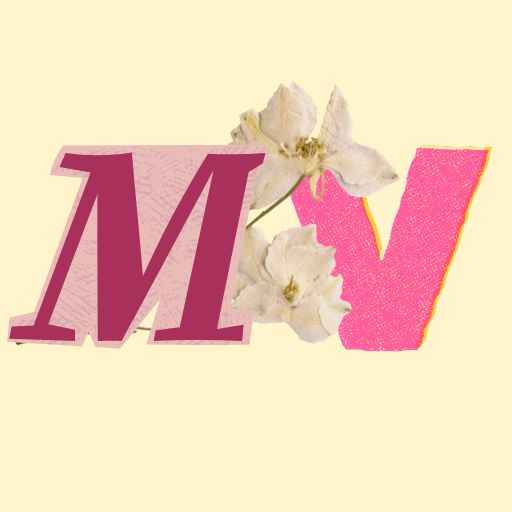
The letters M and V are cutout with a pressed flower behind it.
Photo by Meaghan Van Dyke.

Why This Favicon?

The favicon for this website includes my initials “M” and “V” cut out “scrapbook-style” with a pressed flower behind the two letters. I chose this design because the cut-out, scrapbook look of the letters represents the variety of different media and content-types posted on this website, while still giving it a more personal touch with the pressed flowers. The mark of a perfect favicon includes a memorable design that gives website users an idea of the person behind the website. These were important factors for me to consider while designing my favicon.

How Was It Made?

I created this favicon using Canva. As someone who uses Canva almost daily to design media for the Fine Print Club (an on-campus club I am the proud co-president of), I am very familiar with the tools in Canva and the elements that could be used to personalize the design. First, I chose the color of the favicon’s background, and then used the elements feature on Canva’s website to add the initials, text, and pressed flowers image. I did not use a pre-made template to create this, but rather personalized the ratio of the piece and started blank.

File Type

This favicon is a 512×512 px JPEG, the type of file suggested by the WordPress theme. This JPEG is also a raster graphic, with each individual pixel containing its own color.

Site Header Creation

The letters M, V, and D are cutout above the words "Meaghan Van Dyke Digital Studies" with pressed flowers in the bottom left and right corners.
Photo by Meaghan Van Dyke.

Why This Header?

I created this header to match the favicon of the site as closely as possible. Therefore, I used the same color background, the same color and style of initials, and the pressed flowers in each corner. The only noticeable difference is the pixilation and the “Meaghan Van Dyke Digital Studies” at the bottom. This was added to include the name of the actual site itself in the header.

How Was This Created?

The header, like the favicon, was created using Canva. I chose Canva for both file creations because of my familiarity with the format and the variety of customization options. Similarly to the favicon, I chose the color of the background first, and then layered the initials, subheading, and pressed flowers on top.

File Type

This header is a 2000x300px JPEG file, with the pixilation chosen at the recommendation of the WordPress theme. Since this file is a JPEG, it is a raster graphic.

Copyright in the Creative Digital Space

Overview

Why Is It Important?

In today’s digital world, open access to creative work is as important as ever. However, to prevent the recycling or stealing of artists’ original work, it is important to provide guidelines and restrictions in order to protect work and encourage new creations. Many creators choose to use standard copyright laws that require individuals to seek a license in order to use their work, but many others may also choose to other methods, such as publishing a work directly to the public domain or simply requiring attribution when a work is distributed.

How Is This Site Protected?

For this site, I chose to use CC BY 4.0, or a type of copyright that requires attribution. Essentially, if someone wanted to use the work on the site for remixes, adaptations, or distributions, I would simply just have to be attributed. I chose this option because I would still be credited for my original work while still allowing others to build upon it or distribute it with less restrictions, something I believe is very important in the creative process.

A red shield with a check mark in the middle appears on a computer screen.
Photo by Reshot. Found on Reshot.com

Copyright Rules to Remember

When using the works of others, it is important to educate yourself on copyright restrictions, especially the copyright license attributed to the specific work. While encouraging creativity based on the work of others is a very important part of the creative process, it’s important to make sure the efforts of others and the structure of their original work is recognized by using the proper licensing and attribution. For more information, visit the Creative Commons Website.

A man with blonde hair raises his finger with an idea, while a lightbulb next to him illuminates.
Photo by Reshot. Found on Reshot.com

css.php