Data Project

UMW 2022-2023 Grade Distribution Summary Report
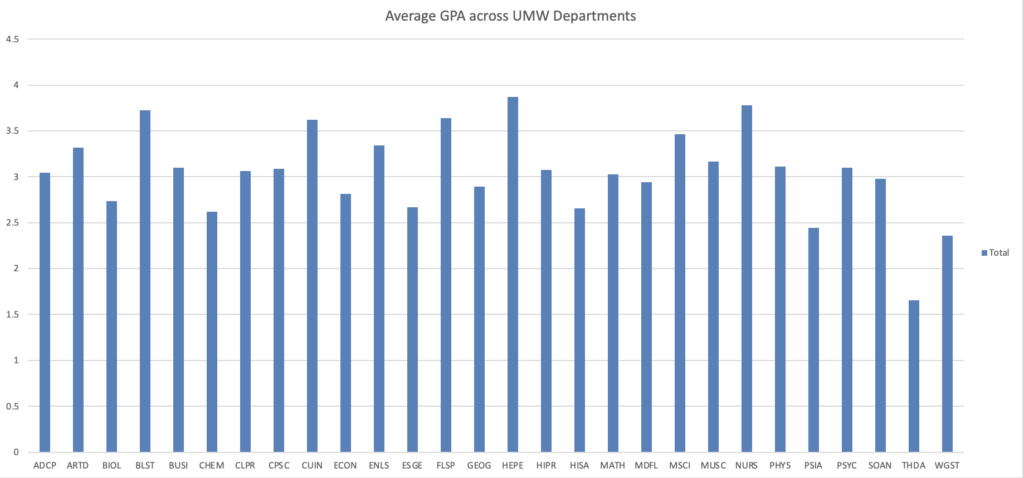
A chart comparing the average GPA of the different departments at the University of Mary Washington.
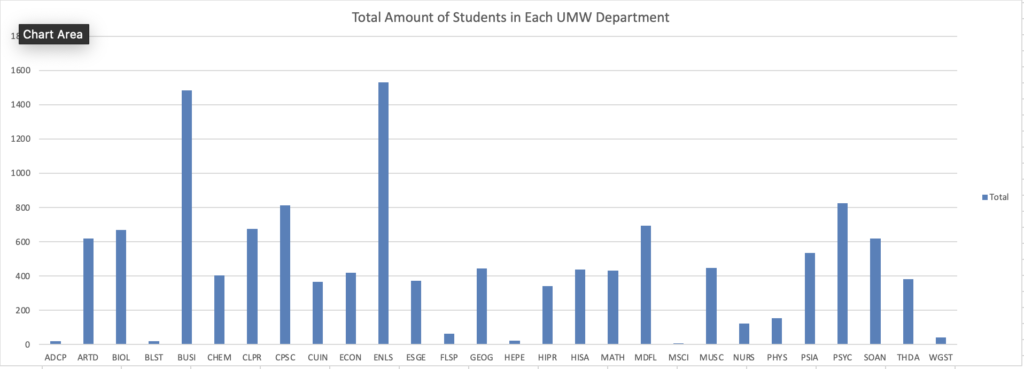
A chart comparing the amount of students in each of the departments at the University of Mary Washington.

The Trends

I chose to focus specifically on the average of the GPA’s of each department at UMW. I found that the departments such as HEPE, NURS, and BLST had the highest average GPA, while departments such as THDA, PSIA, and WGST having the lowest average GPA. The most prominent trend that I could identify was that the departments with the least amount of students would have the highest grade point averages. This could be due to how the average of the the departments with the lowest amount of students are calculated differently to those with a higher amount of students. Another trend is that the departments that are more science-based have a lower average gpa possibly due to the intense curriculum.

The Process

I can admit I do not have a lot of experience at all with spreadsheets. I found any videos, specifically Professor Berge’s video on how to use Microsoft Excel, very helpful, as they explained thoroughly how to accurately analyze data using Excel. I used Microsoft Excel in order to create the data sheet. It made it easy in order to clean up any data that I did not need or anything that wouldn’t be relevant to the trend that I identified. I found the data that I used on the UMW’s site for Institutional Analysis and Effectiveness. They have all the grade distribution summaries dating back to 2017, even including the years during COVID. I specifically used the 2022-2023 Grade Report, as I thought it would be interesting to analyze since those were the years that COVID cases were lowering, and things could go back to normal.
Video Project: The Benefits of Green Spots on Campuses

The Topic

I chose the topic of focusing on green spots around campus because my friends and I love to take advantage of the spaces on campus that are made for students to sit outside and enjoy the weather. In college, you can be stuck inside for the most of the day, even if it is if you are in class or just doing work in your dorm. Outdoor spaces are useful not only just to heighten the aesthetic of the campus, but to also help the mental-health, academic and social life of an individual. In an article by The California Aggie titled The benefits of outdoor study spaces, they emphasize how it can boost productivity, as well as having numerous health benefits. Additionally, in an article by APPA titled Colleges and Universities Should Invest In Outdoor Spaces, they can have environmental benefits as it can conserve natural settings and create a smaller carbon footprint as opposed to building a new academic building. Overall, there are many benefits to having outdoor spaces, and all campuses should utilize them.

Credits and Attributions

In the audio portion of the video, I found the intro/outro music on Pixabay.com called “Vibe Intro”, which does not credit a creator. There is also some sound effects in the background which I also found on Pixabay called “Avala Trail Forest Nature” by dbsound. For the visual portion, I also used Pixabay to find any extra videos I needed, specifically called People laptop team free stock video by Samidurrakzai. I also used Canva templates in order to make the graphics throughout the video.

The Process

In order to record the video, I used my phone to get all the shots I needed. It was also useful in order to get the stable and moving shots, as well as transferring the videos from my phone to the computer in order to edit them. I used ClipChamp to edit the video, which was very easy to use with creating good cuts and transitions between the shots. Finally, I uploaded the video to YouTube, since it is a video platform that I love and use often in order to watch or upload my own videos. It is also very simple to use in terms of creating captions or any possible restrictions that need to be added. Overall, the softwares and equipment that I used made the process a lot smoother.

Video Shot List: “Liv’s College Diaries”

Equipment

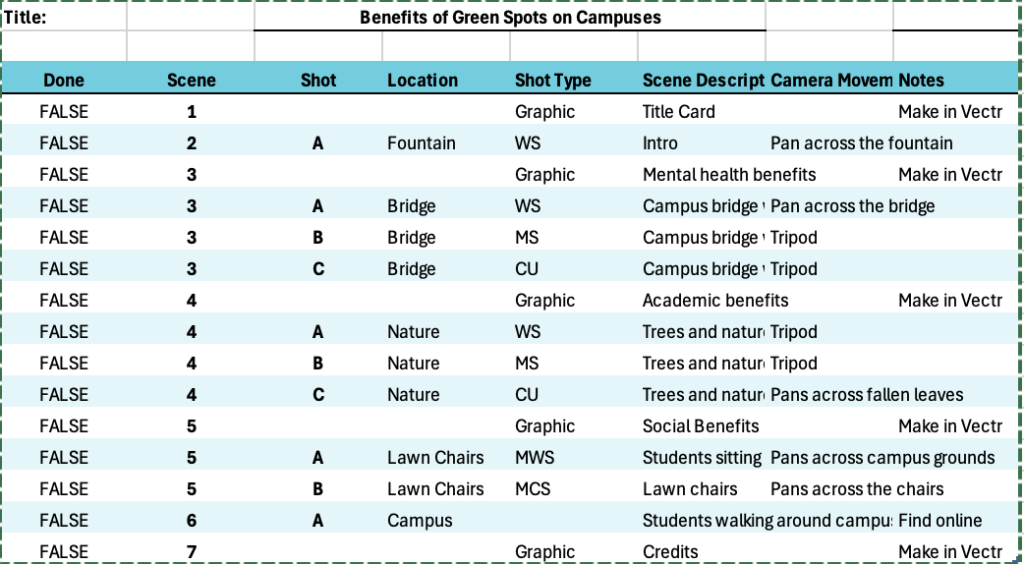
For the video’s that I have to take for this project, I plan to use my phone in order to capture the various videos. I chose this because my phone makes it easier to transfer any videos or audios that I need for the project to my MacBook. I will also use a tripod in order to take more stable videos and shots. With any graphics that I create, I will use Vectr to create the graphics in order to create a coherent atmosphere that goes along with the video. Lastly, any extra images or videos that I find online will be through Pixabay.com.

Visual Material

Throughout this project, I want to use the campus of University of Mary Washington as inspiration for the project. My project is about the benefits of green spots on campus, so I will find the most popular spots, or spots that I personally like, in order to emphasize the main idea of my project. Specifically, I will use shots of the Monroe Fountain, the bridge between the fountain and Seacobeck Hall, and the multiple sitting areas around campus. Additionally, I will use various shots of the trees around campus, which will be especially pretty since the leaves are falling and the colors are changing. All of these areas encourage students to spend more time outside, and it will go perfectly with the topic of my project.

“Liv’s College Diaries”: Podcast Episode

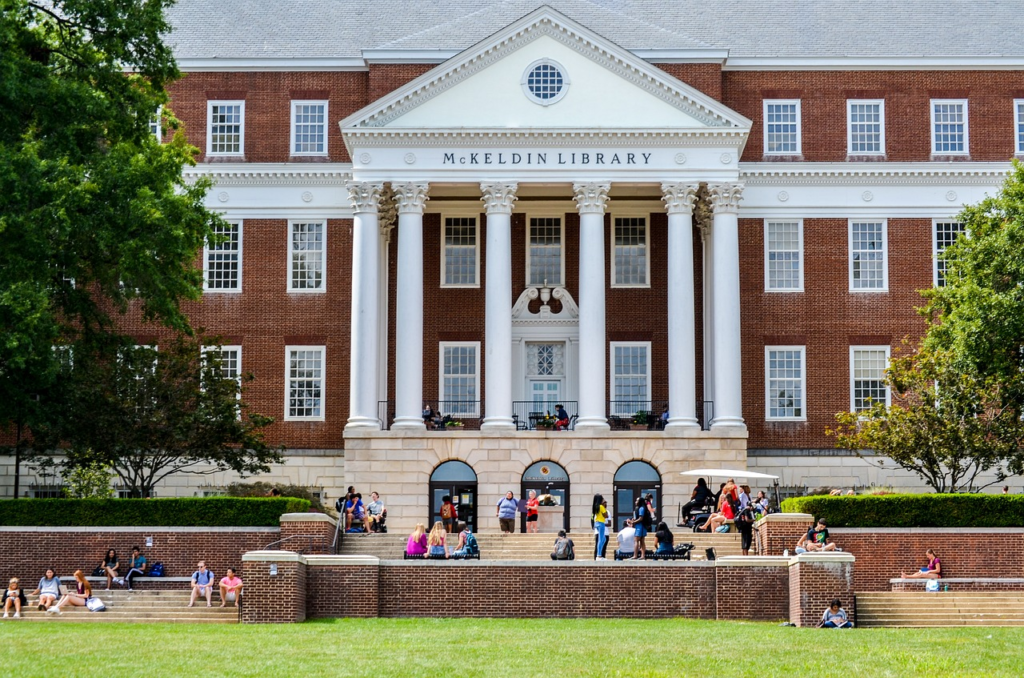
A photo of an old university library. Lot os nature and greenery are seen around it, as well as students enjoying the outdoor spaces.
Image by rainesMD. Found on Pixabay.com

Transcript

Welcome to Liv’s College Diaries, where we dive into the heart of college life. Today, we’re exploring a serene yet impactful part of our campuses, the outdoor spaces. Let’s discover how these green havens boost our well -being, academics, and social connections.

Imagine a place where stress fades away, creativity blooms, and friendships blossom. Outdoor spaces on campus aren’t just pretty backdrops. They play a vital role in enhancing our college experience.

First, let’s talk about mental health. Studies show that spending time in nature reduces stress and improves mental well -being. Whenever I’m overwhelmed, I take a walk around campus. The fresh air and greenery help me clear my mind and recharge.

Next, let’s look at academic benefits. Green spaces have been proven to boost concentration and creativity. Outdoor study sessions amidst nature can enhance focus and inspire new ideas. It’s a great way to break the monotony of indoor classrooms.

Lastly, outdoor spots are social hubs. They’re where students connect, relax, and form lasting friendships. When the weather gets warmer, my friends and I like to set up a picnic blanket and sit outside to enjoy the warm weather.

So next time you pass by a green space on campus, take a moment to appreciate its impact on your life. Whether it’s for mental health, academic performance, or social connections, these outdoor spaces are more valuable than we might realize.

Thanks for listening to Liv’s College Diaries. Tune in next time for more insights into college life.

The Process

The Equipment

In order to record the audio portion of the project, I used the Voice Memos app on my phone to record. It made it easier to transfer the audio file between the different softwares. I also used it to record any extra sound effects or audios to include in the background of the podcast, such as the sounds of nature.

The Software and AI

I used SoundTrap in order to edit the video. I found it very easy to use in order to add the intro/outro music, the sound effects, as well as the transitions between the different topics. It was also very helpful when I needed to cut down some of the talking segments in order to make it fit the time limit. With AI, I used it in order to help me form an outline to the podcast.

Credit and Attributions

Sources

I did my podcast on the benefits of green/outdoor spaces on campus and how they can have a positive impact on students. To read more on how these can directly benefit students, visit OMNIA Partners article titled The Importance of Activating Outdoor Spaces on College Campuses and Learning By Design Magazine article titled Outdoor Spaces Help Promote Mental Health and Wellness on Campus.

Music and Media

For the music and any other extra sound effects that I needed, I found it off of Pixabay. Pixabay allows you to find free audios, videos, images, and even music to use for your own projects.

Podcast Outline: The Benefits of Green Spots on Campuses

My Topic

For my topic, I chose “The Benefits of Green Spots on Campuses”. These are the spots around campus that are outside and encourage students to relax or do work while enjoying the great outdoors. I wanted to highlight this because I find the University of Mary Washington campus to have a lot of great outdoor spots to study or sit with friends. Below is my outline, as well as the prompt that I gave the AI to help with creating the outline.

Outline 

Topic: The Impact of Green Spaces on College Campuses
I will record around different spots on campus, particularly spots that are made for students to use to relax, socialize, or maybe do some work in. I will use my phone to record the audio.
Asked AI to help write an outline.
You
Write me an outline about a two minute audio story about the benefits of having outdoor spots on campus!
Copilot
Here’s a fresh outline for your story:
Title: The Green Escape: How Outdoor Spaces Enrich College Life
Introduction (20 seconds)
Opening sound: Ambient nature sounds (birds chirping, leaves rustling)
Hook: "Imagine a place on campus where stress melts away, creativity flows, and friendships blossom. Outdoor spaces offer more than just a breath of fresh air…"
Segment 1: Mental Health and Wellbeing (30 seconds)
Key point: Benefits of nature on mental health
Example: Interview snippet with a student talking about finding solace in a campus garden
Soundbite: Rustling leaves and a gentle breeze
Segment 2: Academic Performance (30 seconds)
Key point: Studies showing that exposure to green spaces boosts concentration and creativity
Example: Quote from a professor about outdoor study sessions
Soundbite: Typing on a laptop under a tree, birds chirping in the background
Segment 3: Social Connections (30 seconds)
Key point: Outdoor spots as social hubs where students form connections
Example: Brief story from a group of friends who met at an outdoor event
Soundbite: Laughter and casual chatter
Conclusion (10 seconds)
Closing remarks: "Next time you pass by a green space on campus, take a moment to appreciate how it shapes your college experience. Nature's touch might be the key to a richer, happier student life."
Closing sound: Fade out with ambient nature sounds

The Equipment

In order to do the test recording, I decided to use my phone for the audio. I then added the spoken part after so my voice wouldn’t interfere too much with the sounds of nature in the background. Below is the recording, which will have dialogue in the background describing the scenery, as well as interviews with students and faculty to give stories.

The Use of AI

I did use AI to help with creating the outline, as I needed some guidance in what I should put in each segment and how I should distribute the time between each topic. I found it to be very helpful in this aspect, as it gave me a detailed outline, as well as some ideas for what to talk about in the segments or what I should record.

The Why Behind My Website Logo

Why this logo?

I created this logo in order to fully encapsulate how I am as a person, as well as I how I want to portray myself on my website. My favorite colors are pink and green, so I knew I wanted to incorporate those. My favorite season is spring, as it is a time for growth, and the flowers and leaves start to come back, so I put one of my favorite flowers right in the center of my logo. With my heading image, I wanted to incorporate everything that I love as well in it. The phrase “‘Liv’ing My Life to the Fullest”, is a play on my nickname “Liv”. Also, it shows what my goal with this website is, which is to show my projects and to show what I am doing in life.

The Process and File Types

I used Vector to make both of my images. The process I found to be easy, as I had total creative freedom with whatever shapes, colors, or images I could use. The process got a bit harder once I had to figure out what colors would fit, as well as the image and how it would look with the colors. Also, the font would have to fit the aesthetic of the image. I found the flower and natural images on the ‘Elements’ tab on Vector. I thought it was cool how we could look up just key words like “nature” or “flower”, and hundreds of images are free to use. Overall, I thought Vector was an easy site to use, and it made the process of creating a logo a little less daunting. I used JPEG to download my images to the website. I chose this one since it of one of most common image file formats. To read more on why Vector is a good website for creating images, visit Core IDRAW for more information.

A pink circle with yellow sun rays in it. A pink flower resting in the middle with the text "Liv's Life" below it.
Image made my okern on vectr.com
A green screen with green outlined florals and leaves embroidering the image. The text, "Living Life to the Fullest" in the middle, with several flowers surrounding it.
Image made my okern on vectr.com

Copyright and Attribution

Why we use copyright?

Image displays words such as "Copyright", "Idea", "Protection", "Licensing", "Product", "Intellectual", "Patent", "Law", "Global", and "Ownership".
Image by matdesign24. Image found on pixabay.com

I chose the license of CC BY-NC 4.0 because I want people to be inspired by my work and to be able to make it their own. Although, I do not want people making a profit off of it. Copyright is very important, as it gives creators the rights to their own work and provides legal protection. It promotes the production and sharing of art, while keeping it ethical.

Using Other Works Ethically

Closeup of a chalkboard with the words, "Do what is right, not what is easy". Includes a compass.
Image by mohd izzuan. Image found on pixabay.com

Throughout all of my education, we were constantly reminded to cite our work and to give credit to others. Back then it seemed tedious and a lot of work, but it is important as we should always give credit to the original creators of the works that inspire us. The internet is open to everyone in order for people to build off of each other’s ideas, but there are important steps to take in order to make sure no work is stolen. To read more on how to use other people’s work ethically, read Karl Mundt Library’s Citation Guide.

Who Am I On the Web?

Multiple outlines of heads with a specific head having a lightbulb coming out of it. As well as gears, icons, and clouds to indicate the web.

Why I want to share my work?

Why Liv’s Life?

There are many reasons as to why I picked this title for my website. Firstly, for alliteration purposes, as my nickname sounds very similar to the verb “live”. Secondly, it outwardly encapsulates what I want to do on this website, which is to show how I am doing in life and how I want people to perceive me on the web.

Share My Creativity and Work

Throughout my digital studies course, I want to share the work I am doing on this site so that anyone can have access to it as well, whether for inspiration or for enjoyment. Also, I can put any future projects that I want to share on here, as well as being able to look back on them and see what I have accomplished.

Who I want to be on the web?

My Online Identity

I want to create this website in order to create my own personal profile and digital portfolio. Curating my own online identity can show my personality in ways through my different projects. Employers look at candidates in order to see what sets them apart from the others, and to see what will set them apart. This website will help me create my own unique online identity.

Why Students Should Have the Web?

As Audrey Watters mentions in her article, “The Web We Need To Give Students”, she mentions how giving students the freedom to make their own domains or websites allows them to have more agency over their online identity. Instead of restricting them further, it allows students to share their creativity and passions on the web. If you want read more on why students should make their own website, read 7 Reasons Every Student Should Start a Website.

css.php